

Key Takeaways
- Schema and structured data provide a language for search engines and large language models (LLMs) to understand, helping to better organize information and increase its likelihood of being pulled into featured snippets or AI overviews.
- Implementing schema markup and structured data across web pages offers benefits like establishing identifiable entities, improving content extractability, and solidifying Experience Expertise Authoritativeness and Trust (EEAT) signals.
- Best practices to keep in mind include looking for opportunities to implement schema like FAQs, product, and business data while staying relevant with the content and building a strategy for measuring impact.
- We’ve seen positive results at collystring after implementing structured data for our clients, seeing up to a 212% increase in AI overview mentions for some clients.
Adapting To AI Search with Structured Data
Experts in the world of SEO are no strangers to having to change and adapt to new trends, algorithms, and best practices. As LLMs cement themselves in and alter the biggest change in course yet, structured data in SEO has become the next big key to optimizing your site and improving your chances of visibility.
Being intentional about incorporating structured data and schema markup into your site ultimately strengthens your ranking potential for search engine rich results, AI overviews, and LLM responses. While quality content is incredibly valuable in itself, being able to tag this content strategically helps signal to AI tools what that content represents, so it can be easily organized, categorized, and sorted.
Understanding how to implement schema markup across your site can get your content greater visibility and higher click-through rates. Having a strategy for implementation and measurement of success helps you set your site apart and realize results.
What is Structured Data?
Structured data is a standardized code format that identifies important elements on a page to be recognized by search engine crawlers on your site. For example, when looking at a recipe page, the structured data will specifically identify what the ingredients are, how long it takes to prepare, and how other people have rated the recipe.
This markup provides users with some of the most valuable information upfront and allows search engines to easily sort and organize search results based on these indicators.
What is Schema Markup?
Schema markup is a vocabulary of code used to define the structured data that helps search engines and LLMs understand what content is and why it is valuable. Schema markup can be used to tag and label important elements in a page’s structured data so that search engines and AI models can more easily understand the content and text that exists on the site.
Schema markup is a wide net that encompasses many different types of tags that improve Google’s and other tools’ abilities to sort through data and understand the elements on your site. This schema can range from tagging information as the author of an article to tagging reviews as elements of a page.
Common examples of schema markup include:
- Frequently asked questions (FAQs)
- Business data, such as LocalBusiness, Restaurant, or Automotive Business
- Product
- Event
- Person
- Article and author
- Organization
- Review
Many CMS providers, like WordPress, help apply this schema to your site, offering a more plug-and-play experience to easily include the information. However, it’s helpful to review and manually supplement that process to ensure that each section has the proper schema applied and minimize errors.
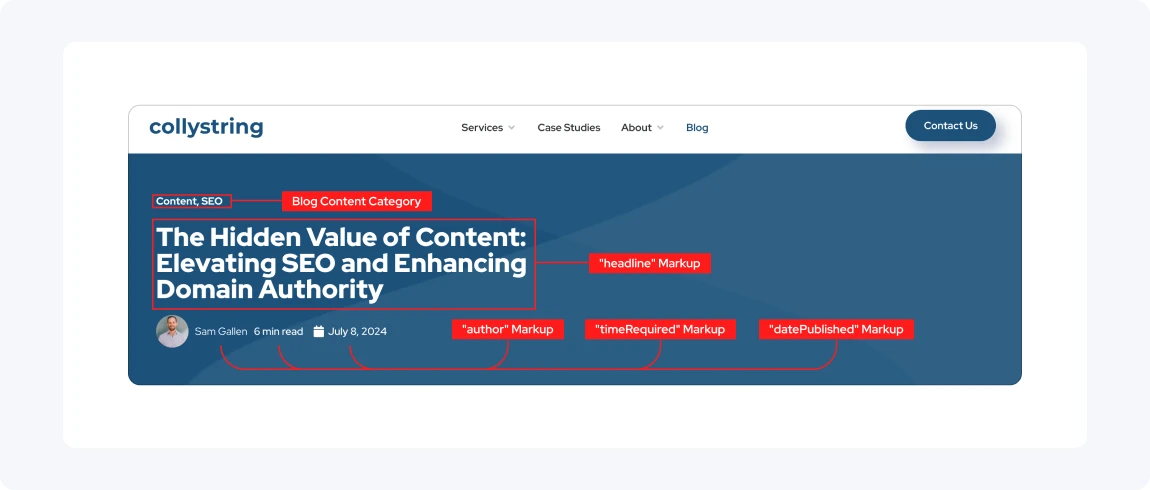
Example of structured data on a blog post.
Benefits of Using Schema Markup
Schema markup provides a language to elements on your website, organizing and delivering important information to AI tools and search engines faster so they can better sort through your content with less analysis, pull it into knowledge networks, and display it more effectively. Schema improves performance by increasing reach and click-through rates, and it offers all the benefits below.
Establishing Entities
Generative engines rely heavily on entities, or unique pieces of information like people, places, and concepts, which go beyond keywords, to understand meaning and relationships.
Structured data and schema markup help define and clarify these entities so that AI models can sift through ambiguity; for example, placing the word “Apple” into the context of software and electronics rather than produce.
By using semantic triples, which include a subject, predicate, and object, within structured data, you can help contribute to search tools’ knowledge graph about a given subject, contributing to a web of information and how it all relates to each other. Adding to this graph expands your site authority by demonstrating it as a source of factual information.
For example, using the Apple entity:
- Subject: collystring
- Predicate: offers service
- Object: Search Engine Optimization
When you translate this relationship into schema markup, it looks like this:
“@context”: “https://schema.org”,
“@type”: “Organization”,
“name”: “collystring”,
“makesOffer”: {
“@type”: “Offer”,
“itemOffered”: {
“@type”: “Service”,
“name”: “Search Engine Optimization”
This clarity ultimately improves search visibility, allowing Google to know when to pull your content and for what concepts. It also makes your site more likely to be picked for responding not only to a singular query, but also to many synthetic subqueries. Following the same example above, schema can help you rank not only for Apple as an entity, but also a variety of other related lexical queries and subqueries, such as “California-based tech company” or “company that makes the iPhone” that are related despite not having the same keyword.
Improving Extractability for Fraggles (AI ‘Chunks’ and Passages)
AI systems often prefer content that is broken up into fraggles, also known as fragmented passages of content that can be cleanly taken out of text and turned into a featured answer.
In other words, when information is grouped together, it’s easier for AI tools and search engines to parse out and present it through AI overviews and rich results. Certain schema types help signal that content is already structured for simple extraction.
These types of schema are all beneficial for improving extractability via Fraggles:
- FAQPage Schema provides a section for clear and concise answers to common questions, signaling to AI tools that a concise answer exists, often favored for extractability purposes.
- How To Schema breaks procedural content into discrete steps, allowing agents to reformat instructions into checklists or summaries for users.
- Product and Offer Schema is particularly beneficial for ecommerce related sites for pulling information and comparing products with precise data points.
Altogether, these elements can provide clear direction to AI tools and search engines for how to understand content. Ultimately, these tools are going to pull from the area where they have to do the least effort. By implementing schema markup and doing this work upfront yourself, you remove the barriers to information for the AI and search tools so that they can easily pull and feature your content in rich results.
Establishing Authority (E-E-A-T) and Trust
For LLMs – and often Google – trust signals act as tie-breakers, using the authoritativeness behind two similar segments of information to determine which to favor. If two pages provide similar information, the AI is likely to cite the information provided from the more reputable domain.
Organization and person schema can help AI models identify the brands or experts behind the content, thereby improving signals for Experience, Expertise, Authoritativeness, and Trustworthiness (E-E-A-T). Improving embeddings, like detailed schema regarding authors and organizations, helps cluster related concepts together in one group, improving site-level embedding and increasing the odds of retrieval.
Best Practices To Follow with Structured Data
Implementing structured data thoughtfully is a crucial strategy for keeping up with the shifting SEO landscape. Follow the steps below to make your pages stand out.
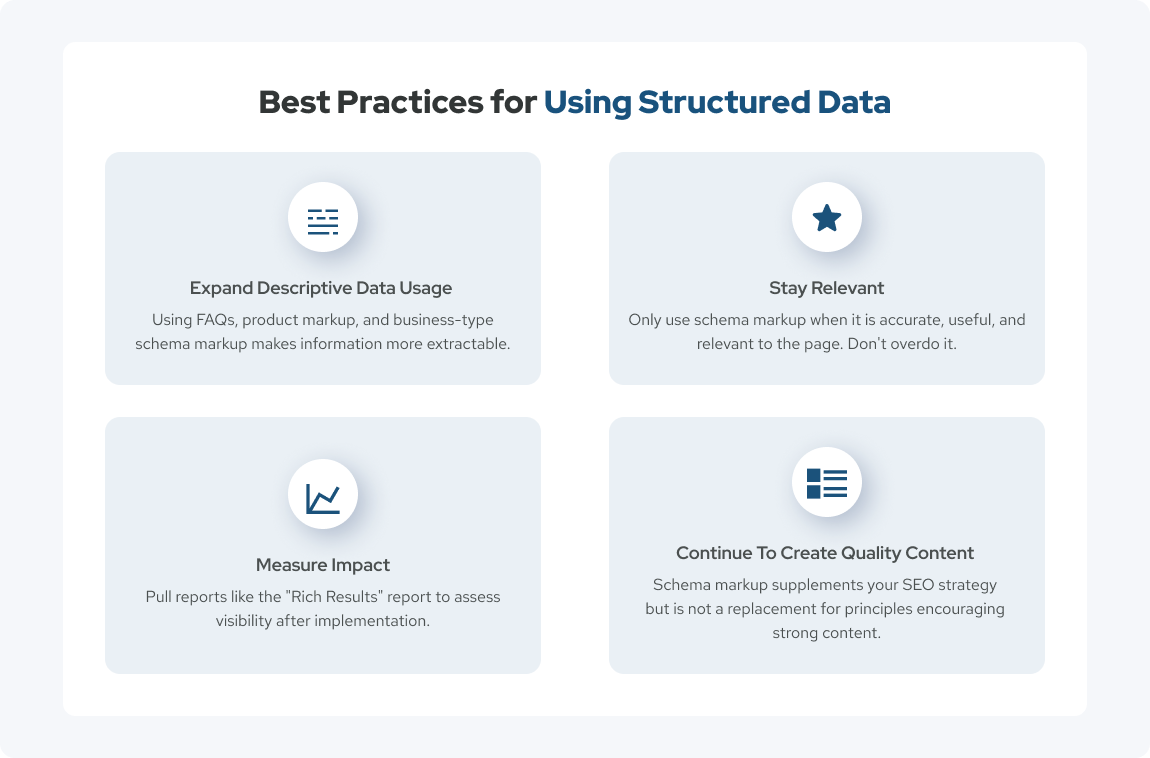
1. Expand Elements Like FAQs and Descriptive Data
Elements like FAQs, product markup, and business-type schema markup help enrich web pages and make information more accessible for websites across industries, from small local businesses to large SaaS companies. Think about elements of your site that can most benefit from schema markup.
If you are selling products, for example, schema markup can be particularly beneficial for a field like ecommerce. Having reviews, pricing information, and descriptions for your products allows these to be highlighted in shopping results and commercial intent-focused SERPs.
Similarly, if your business is a local business, having markup across multiple pages will help search engines know to display information about operating hours in rich results for those seeking your services.
Business subtypes, like LegalService, MedicalBusiness, or Food Establishment, can help describe your business even further, so that the search engine can put the information in front of those who will find your business most relevant to them.
2. Stay Relevant
While structured data signals are helpful for enriching your pages, it is important that they are fit for purpose. To be most useful, only use schema when it is accurate, useful, and relevant to the page. To consider some examples:
- If a frequently asked questions page would be excessive for a given topic and wouldn’t enrich the content overall, don’t implement it.
- If your page does not include any reviews, then you should exclude any review schema.
- Only implement local business schema on the Homepage, About page, Contact page, and service pages, rather than across your whole site.
- Ensure that the schema includes accurate and up-to-date information.
Implementing schema when it is not necessary or when it is not correct could signal to Google that your schema is inaccurate and unreliable, affecting your reputation across your entire site, ultimately weakening your ranking potential.
3. Measure Impact
Ongoing measurement is crucial to determining whether schema markup is driving results for your site. While schema markup is not, in itself, a ranking factor, it can supplement your SEO efforts and lead to both greater visibility and higher-quality traffic by pre-qualifying videos. Gather reports to see whether that markup is resulting in more rankings in rich results, as well as whether that visibility is turning into more clicks and conversions.
Using the Rich Results report in Google Search Console can help you assess how your content is performing. Additional tools within platforms like SEMrush, Ahrefs, and more are also becoming increasingly available for tracking AI visibility and rich results performance.
4. Continue To Create High Quality Content
While the SEO atmosphere seems to be constantly and drastically changing, the foundational best practices have not changed, as many defining principles of high-quality content are the same. Headings, bulleted lists, a clear content flow, and all the crucial best practices we know and love are still crucial for helping search engines and LLMs understand and effectively rank your content.
Schema markup helps get your content pulled into the spotlight, but having quality, accurate, and authoritative content is the foundation for getting your content recognized by search and in AI tools.
How To Implement Schema and Structured Data
You can implement schema and structured data using several methods or tools that interact with the backend code of your site. The following are the most popular syntax methods for sharing and implementing structured data:
- Implementing JSON-LD – Short for JavaScript Object Notation for Linked Data, this code can be quickly edited and adapted.
- RDFa – An HTML5 extension that embeds data into HTML to mark up elements like People, Places, Events, or Reviews using attributes.
- Microdata – A method that embeds data into your existing HTML tags to label content on a webpage to help search engines understand the text.
Of these approaches, JSON-LD is the definitive standard method for schema markup, as it is the easiest to edit and adapt, and the format explicitly recommended by Google. As two HTML-focused methods, Microdata and RDFa present the disadvantage that they are both difficult to test and can lead to errors when elements are rearranged on a site if you do not reconfigure the markup.
Are Structured Data and Schema Markup Worth It?
While there are two sides to the value of implementing structured data and schema markup, these strategies are ultimately worth it. To some, the time and energy that it takes to implement these tools may feel like they outweigh the potential benefits, as schema markup is not a ranking factor in and of itself, according to Google.
However, the indirect benefit of helping search engines understand your content so it can be applied to rich snippets and expand click-through rates is often worth the effort.
Often, it’s about having the right workflow so that you are able to implement this strategy without straining your resources. Focusing on traditional SEO methods, like technical SEO and quality content generation, should remain a priority so you aren’t putting all your eggs in one basket either. Schema markup doesn’t overtake your current strategy; it adds to it.
With a strong team to support you in implementing this schema markup across the most valuable opportunities on your site, you can adapt without harming your other efforts. collystring acts as an extension of your team, allowing you to focus on your business priorities while we help you spike performance.
What We’ve Seen at collystring
At collystring, we’ve found considerable success in implementing structured data and schema markup for our clients. We’ve been working to keep our clients ahead of the curve by bolstering their SEO strategies with structured data, and we have already seen promising results.
Local Medical Clinic
For a local medical clinic client, we implemented FAQs across all primary pages in December 2025, focusing on content that was specific to each service line. We covered information like how the clinic operates, what insurances are accepted, and what a typical visit looks like, as just a small portion of the examples.
In just one month, overall mentions in LLMS increased from 93 to 144. These changes not only helped improve the site’s visibility in search but also gave users accurate and easy-to-find information about how the clinic operates.
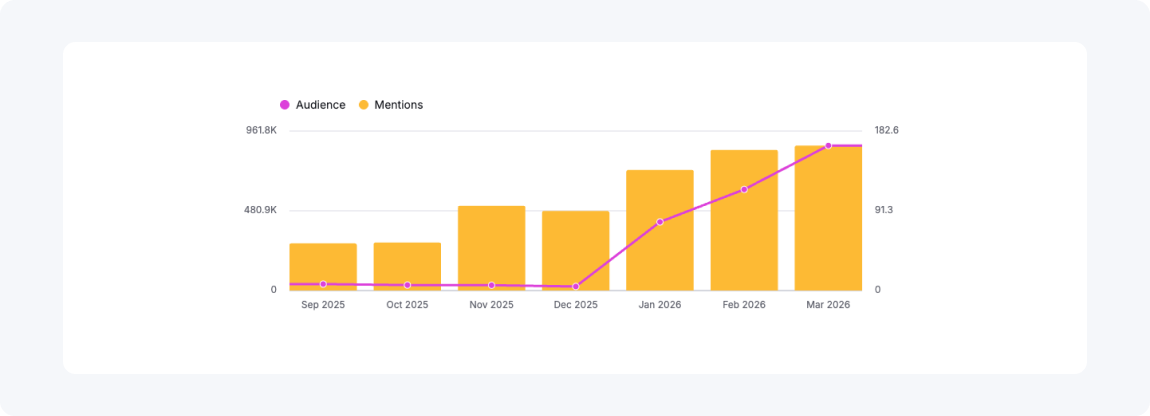
Law Firm
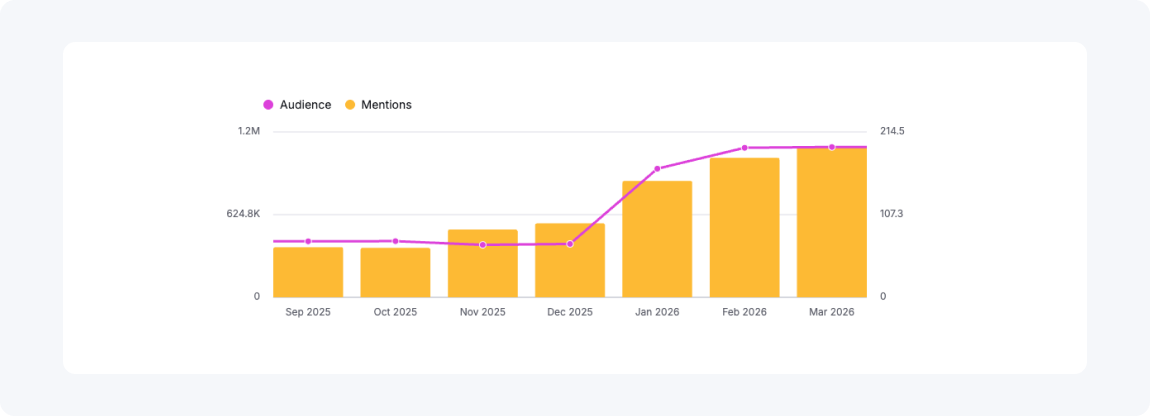
To boost search visibility for one of our law firm clients, we implemented a sitewide schema project to generate schema across a variety of types, including Service, LocalBusiness, Article, FAQ, and more. Within just two weeks, we saw total mentions across LLMs and AI Overviews increase by 48%. After two months, these mentions increased by a total of 212%. Blog content received the most mentions, but location and service pages also saw improvements in visibility, audience size, and potential traffic.
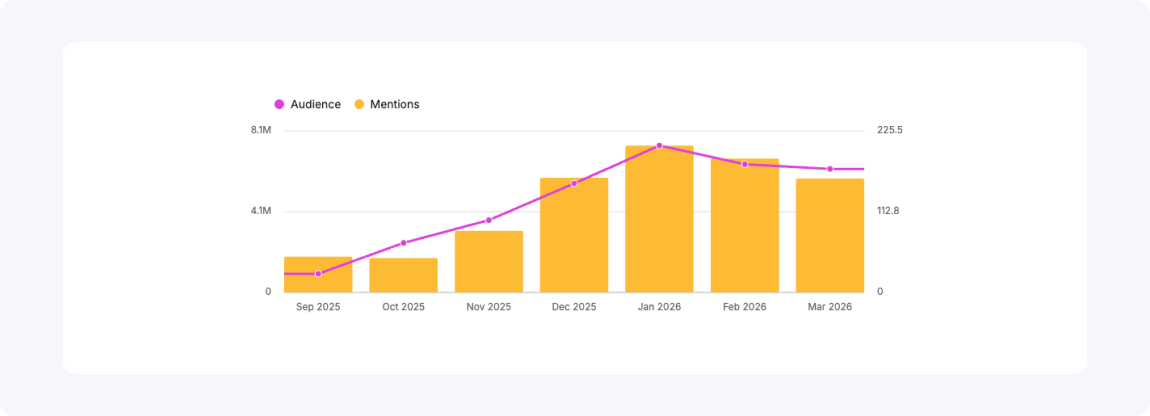
SaaS
To expand the footprint of one of our SaaS job placement clients, we implemented a JobPosting schema to support hundreds of dynamic job posts across their site and built out a robust schema, including multiple variables pulled from the job posts themselves. Within a month, we saw the number of mentions of job posts in LLMs and AI Overviews increase 53%, and Audience Size grow 106%.
Start Ranking Higher with collystring
Structured data and schema markup can be difference-makers in increasing your site’s search rankings and visibility. Developing a thoughtful strategy that involves strategic business data, FAQs, and similar signals helps you keep up in an environment that prioritizes well-organized, grouped, and authoritative content.
Although valuable, diving into structured data and schema can be complex and time-consuming, making a strategy difficult to sustain. Having the resource of go-to seasoned Search Engine Optimization experts, like the team at collystring can help. To improve your search and AI visibility without the headache of having to sort through complex backend processes on your own, get in touch with the team at collystring.
Contact us to schedule a discovery call today and discuss a clear roadmap.