


Key Takeaways
- Meta Advantage+ is a suite of tools for audience targeting in Meta ads, which utilizes the algorithm to determine which audiences to market and display ads to.
- Meta Advantage+ is beneficial for increasing audience reach and works well when your audience has clear signals, and you can allocate a sufficient budget.
- Meta Advantage+ may fall short when it comes to identifying the best signals for niche audiences and delivering high-quality leads.
- The key to finding the right use of Meta Advantage+ is continuous testing for clients and reviewing which ones get the best returns in leads.
Meta Advantage+ Pros and Cons
MetaAdvantage+ is a difficult case to crack—while it has some benefits for expanding reach, it doesn’t always return the best lead quality and makes you feel like you’ve relinquished too much control. The idea behind Meta Advantage+ is to create a hands-off approach to Meta ads by allowing the algorithm to guide your ad targeting. However, placing all your faith in an algorithm and taking your hands out of the process is cause for hesitation when the algorithm’s instincts may be misguided.
As with any tool, the solution is to find a middle ground that works. In some cases, testing might tell you that yielding to Meta’s algorithm will provide better ROI, while in others, it might show that you need to adjust your targeting manually to reach higher quality leads. Often, the tool’s success depends on the industry you are marketing in and the types of audiences you are trying to reach.
Our team has experienced both sides of the coin, with two of our Paid Social experts, Amber and Megan, each having their own insight and opinions on the benefits of Meta Advantage+ based on how they use it for their respective clients. This guide breaks down the pros and cons of Meta Advantage+ from the perspectives of our team.
What Is Advantage+?
Meta Advantage+ is one of Meta’s newer suites of tools in Meta Ads Manager, which utilizes machine learning and automates audience targeting based on audience information. The idea behind Meta Advantage+ is for marketers to be able to be as hands-off as possible with minimal setup required.
All you have to do is identify your objective, add products and creatives, and set your budget. From there, Advantage+ uses the algorithm and Meta’s machine learning to determine who sees your ads, where they appear, and allocate and reallocate spend based on audience signals. This allows the algorithm to refine targeting as it learns how audiences engage and behave on the site, rather than having to make the call yourself.
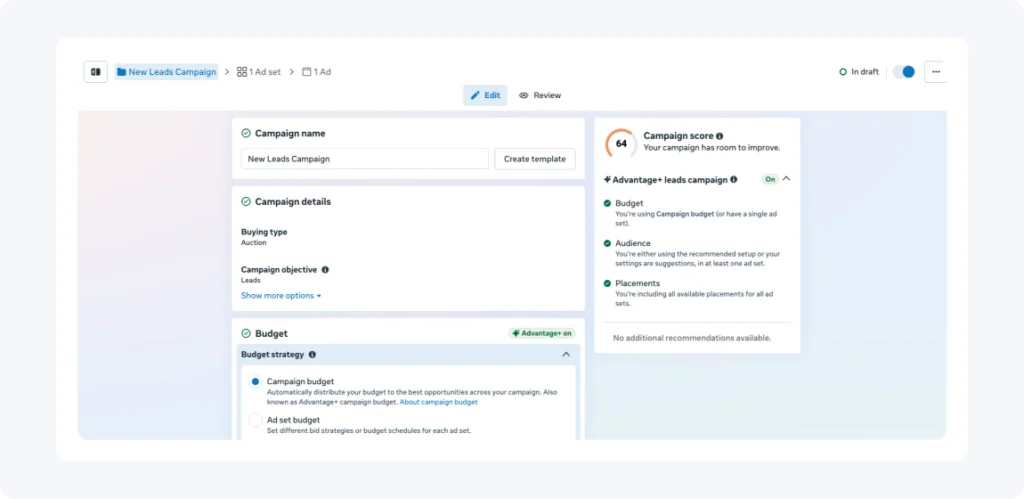
In many ways, Meta Advantage+ is a response to iOS’ growing privacy features and updates. Privacy features like link tracking protection have made it challenging for marketers to gather signals on user behavior to refine their targeting. By using audience behavior, Meta can use its own signals to adapt its targeting. You can either allow Meta to operate off of its own intelligence or you can upload first-party data to guide its targeting.
It offers the benefit of convenience, but lead quality can vary depending on the data Meta uses against the data you have available. Plus, placing all control into the algorithm is not something all marketers are enthusiastic to do.
A Case for Meta Advantage+
Meta Advantage+ can offer you a lot of convenience and flexibility. Setup is fast, launching campaigns is simple, and you don’t need your hands on every single lever to see results. Many marketers not only enjoy the time it frees up, but also find that it can genuinely increase audience reach and bring new eyes to your brand.
Rather than having to focus on audience-building and refinement from the user seat, you can focus more on scaling your campaigns based on the audiences that are working and based on your ad strategy. When things are going well, Meta Advantage+ will offer you the following benefits.
Benefits of Meta Advantage+
The most significant benefits of Meta Advantage+ lie in its ability to increase reach and scale campaigns to push your ads farther. When you give freedom to the algorithm for targeting, you may see:
- Prevents pigeonholing your brand and increases recognition, even with audiences outside your niche.
- A less-restricted algorithm brings better performance with more freedom to expand your audiences.
- It makes it easier to scale when it’s working well, with less manual audience-building necessary.
- It can automatically shift budget toward Meta placements that drive the best conversions based on what’s working, rather than manually adapting the budget per placement.
All together, you provide the audience signals and creatives, and the platform starts optimizing across channels. When signals are strong and the algorithm is effective at targeting the right leads, Meta’s ability to optimize can be a significant relief and support system for small or busy marketing teams.
Nuances
Still, of course, using Meta Advantage+ is not always the magic solution for automatically pulling in tons of leads, even at its best. How and when you use it is the key to making the most of it.
Consider these nuances to get the most value out of the platform:
- You can still add exclusions to your targeting, even when leaning on Meta Advantage+.
- Instead of tailoring audiences, try tailoring creatives with more variations of different messaging.
- Having more creative options gives Meta a better ability to test more combinations and make adjustments as it goes.
- Use Audience Settings and Audience Controls to set up existing, engaged audiences to view via Audience Segment Breakdown and get a clearer view of who is being served.
| Pro Tip: You have to play Meta’s game to some degree. The algorithm is going to favor the efforts that use its tool, which puts you in a position where you may need to try it and see if it works before ruling it out entirely. In general, you have to put some level of trust into the algorithm, which can be tough for some. Our job as an agency is to find the balance between client comfort and performance. |
Use Cases for Meta Advantage+
We’ve found Meta Advantage+ to be the most successful in the following scenarios:
- When clients have broader audiences that are less niche
- When clients aren’t attached to very specific creatives
- When there’s more budget available
- When accounts have a historical record with healthy conversion rates and first-party data to back it up
- When clients are in the ecommerce space with strong conversion signals
In our experience, Meta Advantage+ works particularly well for ecommerce clients. After all, ecommerce provides clear signals from audiences when they make a purchase or add an item to their online cart, leaving little room for ambiguity.
A Case Against Meta Advantage+
Despite its potential benefits, Meta Advantage+ isn’t always going to be the answer for what you or your clients need. The algorithm still has several potential limitations, including low-quality lead signals and unpredictable targeting. Meta often attempts to get you to opt in to Advantage+ settings either by default, which many are not enthusiastic about when the results are so mixed.
From having less control over how spend is allocated to not being able to understand the logic behind the algorithm’s ad targeting, Advantage+ has left many marketers feeling like they have relinquished too much control to see the high-quality leads they are looking for.
Drawbacks of Meta Advantage+
- The algorithm often optimizes for the lowest-friction leads rather than the highest-quality leads, and may target people based on accidental clicks or actions like form fills that may result in lower lead quality instead of targeting based on your preferred criteria.
- Retargets prospects too often
- Meta controls how spend is allocated, which may drain your budget and make it harder to set guardrails
- Because Meta controls targeting and refinement, marketers may not always be able to easily understand why certain creatives or campaigns perform better than others to guide future strategy
Poor lead quality tends to be one of the biggest concerns among social media marketers. Meta Advantage+ alone is not always the best at determining which audiences to display ads to, which results in prospective leads who aren’t as likely to convert as you would hope.
For example, the algorithm may refine its targeting based on a lower quality lead like a Marketing Director, rather than a CEO, who has the ultimate purchase decision. While both positions have shared algorithm signals and can count as a lead, the CEO is the one we actually want to target for a service that needs company buy-in. Displaying ads to the CEO means a higher chance for a full conversion.
Using custom conversions has been a game-changer for us, ensuring the algorithm learns from our ideal event types and conversion events, such as a specific form fill or website interaction, to deliver better signals based on past actions.
Even with considerable ad spend, marketers may still find that their database contains a lot of low-quality leads unlikely to result in meaningful purchases or actions. Because of the challenges that come with letting MetaAdvantage+ run its own course, the key is knowing when to use it.
Where MetaAdvantage+ is less effective
- You have a niche client or niche product
- You have a low budget
- When optimizing for a standard event, as it can cause a conversion event to be convoluted (For example, a higher education lead can be anyone who submits an RFI, but if you are spending budget on a specific degree type, you want leads to submit RFIs for that specific degree)
- You have an account with very little history behind it, and little conversion volume to go off of
- When you have few creatives to work from and test
- When you don’t have the minimum of 50 conversion events per week to optimize effectively.
In some industries, signals for leads don’t always translate into publishers. For example, in cases like law firms or higher education clients, conversion signals may be very limited, with interest form sign-ups or applications being far lower volume than purchases for an ecommerce client. As a result, the algorithm may have a hard time learning and refining for such a narrow scope.
When you need to target a hyper-specific audience with lower volume, manual testing is often best for identifying which signals result in the highest quality leads. The platform optimizes across all variables simultaneously, which can make it difficult to narrow down why your campaigns are underperforming.
Make Sense of Meta Ads
Meta Ads can be a roller coaster of emotions—our team at collystring will help you navigate the challenges of Meta Advantage+ and develop a strategy to get your ads in front of the right audiences.
Where We’ve Landed as an Agency
Meta Advantage+ has a place in a Paid Social strategy, but there are still situations where manual targeting may work better—the key is testing for your client and their audience. While Advantage+ may have its imperfections, whether it’s worth using depends on the type of campaigns and the type of client, as we’ve found success with businesses with broader audiences and a high volume of conversion signals while also running into challenges with more niche clients.
As with any new tool, we expect Advantage+ to be refined over time. As it progresses, if it improves in the signals it uses and strengthens lead quality further, we will find ourselves using it for even more of our niche clients.
To walk the fine line currently, we have found that we benefit from a balance where it’s worthwhile to run manual campaigns for learning, then use Advantage+ to scale. Using first-party data has also helped us strengthen lead signals and make the most of our targeting through the platform.
Ultimately, with the right approach, Advantage+ can be a strong lead generator. While giving up control can be stressful, it does have its use cases and has allowed us to scale successfully for many clients. Success just requires a bit of patience to test for, adapt, and offer the best possible conversion signals.
| Using MetaAdvantage+ for Audience Targeting | |
| When It’s Helpful | When It’s Not |
| When clients have broader audiencesWhen you have strong creatives to drive engagementWhen Meta Ads are a lower priority in your overall marketing efforts.When you have a larger budget for itWhen you have a high volume of creatives to test | When you have a niche audienceWhen you don’t have strong conversion signals for your target audienceWhen you have a limited budgetWhen you want greater control over your targeting and testing When you want insights regarding which ads perform well and why |
How We’ve Used Meta Advantage+
We’ve used Meta Advantage+ across a variety of clients since its introduction. As a new tool, it’s important that you understand its ideal use cases and when your judgment still beats the algorithm.
| A Scenario For: For an ecommerce beauty brand client, we tested 10 different audience splits in 12 months, and unfortunately, all of them tanked pretty quickly. Using Meta Advantage+ campaigns to refine audience targeting gave us a boost and helped us connect with more of the consumers we were hoping to reach. |
| A Scenario Against: For a higher education client, we found that Meta Advantage+ targets people who don’t meet the base qualifications for targeting, pouring spend into the wrong direction and failing to return quality leads for a specific program that has allocated spend or direct spend against its ROI. |
No matter what, testing is always the best approach. Try launching campaigns via Meta Advantage+ first, and test against your own manual targeting to see which drives the most returns if testing falls short. If you hit a wall, a manual approach can help you diagnose performance problems or test new variables.
Get Your Meta Ads To Perform with collystring
MetaAdvantage+ has its benefits and drawbacks, so knowing when to use it is half the battle. You often have to play Meta’s game to some degree to get reach, but the algorithm may not always know what’s best. It takes continuous testing and expert judgment to know how to leverage MetaAdvantage+ and how to pair your campaigns with the best creatives.
At collystring, we’re constantly testing to find out what works. Our Paid Social team uses a balance of our industry expertise and consistent testing to determine the highest-performing approach for each client and campaign. We are continuously learning and adapting to new tools and updates across social media platforms so we can bring meaningful results.
Reach out to us to schedule a call.