

Key Takeaways
- Modern content needs to serve human readers who crave useful, engaging writing and LLMs that need concise, easy-to-understand material so it can be surfaced in AI-powered search experiences.
- Answer-first optimization can help both audiences find what they are looking for by presenting the primary answer before laying out the supporting context that fleshes out the topic more thoroughly.
- Thoughtful formatting elements, including descriptive headings, short paragraphs, lists, tables, and FAQs, can make content easier for people to navigate and for AI systems to interpret.
- Query fan-out can help determine how broadly a topic should be covered by breaking a core search into a bunch of related sub-questions that reveal the full scope of user intent and the adjacent subtopics that should be addressed.
Present-Day Content Must Work for Humans and LLMs
The way people find and consume information has changed significantly since collystring entered the digital marketing space about a decade ago. More and more users are opting for AI-powered search experiences, so we have been working hard to ensure content serves both large language models (LLMs) and the people who ultimately read the pages.
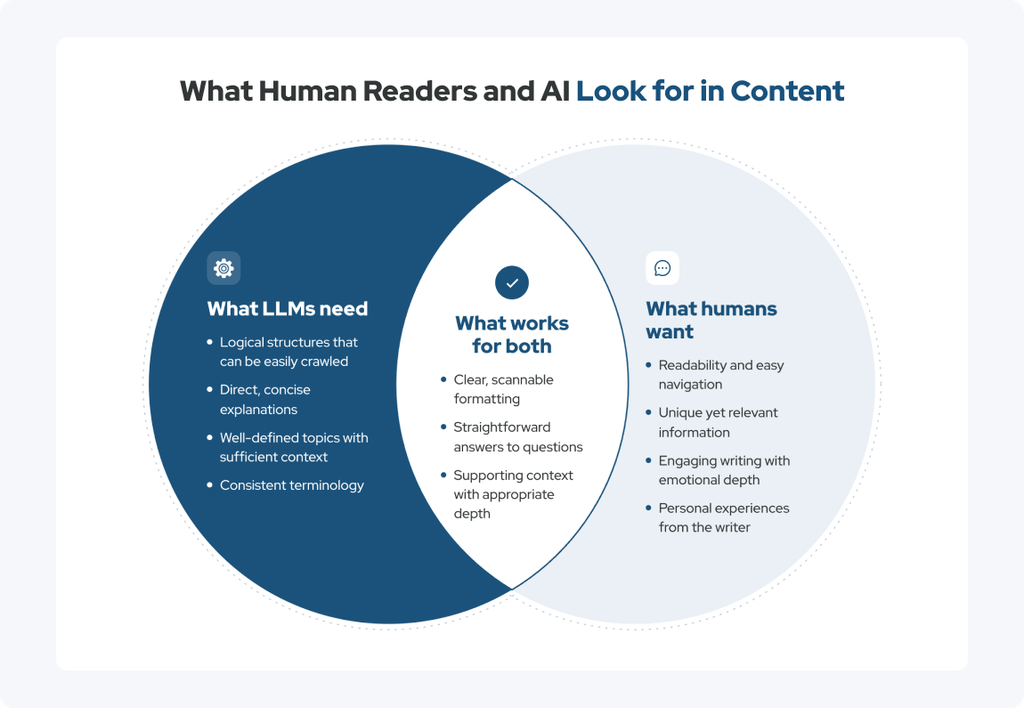
It is important to know that LLMs tend to prioritize clear, concise content with a logical structure, as that is what is easiest to interpret, summarize, and repackage to users. Humans too value clarity and readability, but they also gravitate toward relevant, engaging writing with emotional depth and the inclusion of personal experiences.
Finding an overlap between traditional and large language model search engine optimization (SEO) is crucial for brands operating in the current digital landscape. However, before you can understand how to balance SEO for LLMs and humans, you should understand how SEO practices have shifted over the years and what humans and artificial intelligence are looking for these days.
How Has SEO Changed Due to AI?
Traditional SEO has largely centered around considerations like:
- Keywords
- Search intent
- Search volume
- Relevance
- Authority
Those fundamentals still matter today. However, content teams now have to consider how easily AI systems can understand what their page says and determine which information is relevant to a particular query.
Still, content should not be written exclusively for machines. In many cases, the same structures that make information easier for an AI system to interpret can also make content more human-friendly.
What Works Best for Each
Human readers respond best to clear, engaging content that is relevant to their query, and LLMs prioritize well-structured, context-rich content—there is considerable overlap between what makes content useful to both, making dual human and LLM optimization possible.
Four To-Dos of Making Content Work for Both Humans and LLMs
Modern content strategy does not require choosing between traditional SEO and AI search optimization practices. Instead, marketers can make the following relatively straightforward changes to improve the experience for both audiences simultaneously.
1. Lead With the Answer
People increasingly expect quick answers from search engines and AI platforms. To appeal to them, you should answer questions as early as possible. Doing this can also make the primary answer easier for an LLM to identify when processing the page for a related query.
A Real-Life Example
If someone searches “How long do roofs last?”, they probably do not want to read about the various factors before learning the answer.
Less effective response:
There are many factors that cause roofs to have different lifespans, from the durability of the material itself to the weather conditions it is subjected to. How well the roof is maintained also plays a role; someone who schedules consistent inspections and repairs may get around 30 years out of their asphalt shingles, while someone who neglects care may only get 20.
More effective, answer-first response:
Asphalt shingle roofs last about 20 to 30 years on average. However, factors like climate, installation quality, and maintenance can affect lifespan.
The second example will likely be preferred by humans and LLMs alike because it immediately provides the desired information before mentioning nuances.
Answer-first writing does not mean every page needs to be stripped down to a few sentences. It is simply about putting important information front and center rather than buried beneath unnecessary setups.
2. Format Content in a Logical Way
Formatting affects how easily information can be understood. For instance, a page consisting of long blocks of uninterrupted text can be difficult for readers to scan and can make relationships between ideas less apparent. Clear organization gives both people and AI systems stronger signals about how information fits together.
If you are looking for content formatting tips, some useful structures you can include are:
- Descriptive H2s and H3s
- Short paragraphs
- Bulleted and numbered lists
- Tables
- Bolded key information
- Frequently asked questions (FAQs)
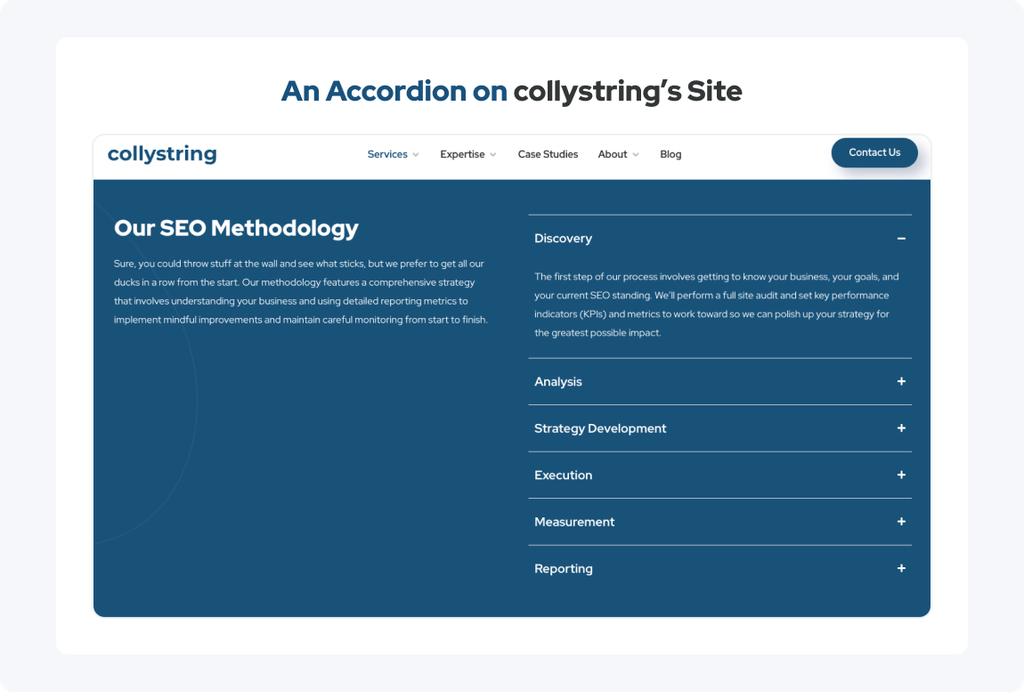
Accordions can also be helpful when information is relevant but does not need to occupy prominent space on the page. collystring often provides a concise answer in the visible content, then places supporting details in an accordion to keep the primary experience clean while still providing additional information for users who want it. Nevertheless, accordions should not become a dumping ground for huge amounts of secondary content.
3. Find the Right Content Length
Making blogs and service pages longer doesn’t automatically mean you are maximizing the value of written content. On the contrary, adding thousands of unnecessary words to a straightforward topic can make a page harder to navigate without providing meaningful additional value.
A simple question may require only a few paragraphs, while a complicated subject could justify a comprehensive guide, as illustrated by examples in the table below.
| Query | Appropriate Approach |
| How long do asphalt shingles last? | Give a quick, direct answer |
| How do I choose a roofing material? | Explain multiple factors and considerations |
| How do I install shingles myself? | Provide a detailed, step-by-step resource |
An effective content team should consider several factors when determining how much information a topic warrants, including:
- Traditional search results
- AI-generated results
- Competitor content
- User intent
- Topic complexity
- Related questions users may have
Figuring out how to provide enough information to satisfy the intent behind the query leads us to another important concept: query fan-out.
4. Understand Query Fan-Out
Query fan-out is the process of an AI system breaking down a user’s original question into multiple related searches or subtopics to construct a broader answer. Understanding how broadly AI systems treat a query can help you decide how much content belongs on a particular page.
For a query such as “How do I choose a roofing material?”, an AI system may consider related questions about things like:
- Cost
- Lifespan
- Climate
- Maintenance
- Appearance
- Energy efficiency
Therefore, a page targeting this topic may benefit from addressing those related considerations. By contrast, “How long do asphalt shingles last?” probably does not require an extensive guide covering related topics like the history of roofs and different types of materials available.
Lean On SEO and Content Specialists
The experienced content writers and organic search specialists at collystring are at the cutting edge of SEO for AI search.
Using AI Results to Inform Content Structure
AI-generated answers can provide useful clues about how systems interpret a topic. Marketers can study AI results and look for patterns such as:
- Questions that AI consistently answers together
- Topics that repeatedly appear in responses
- How much context AI provides
- Whether information is presented as lists, explanations, comparisons, or steps
- Which concepts appear essential versus secondary
Don’t just copy an AI-generated response; use your observations to better understand the information architecture surrounding a topic. If AI systems consistently connect a primary question with several related considerations, that may indicate those concepts deserve to be included in your content strategy.
During my time as a Sr. SEO Manager at collystring, I have used this approach to help identify opportunities to restructure existing pages. I’ve found a few pages that technically address a topic but bury important information, use unclear headings, or spend too much space on secondary details.
The Best Structures Often Work for Both
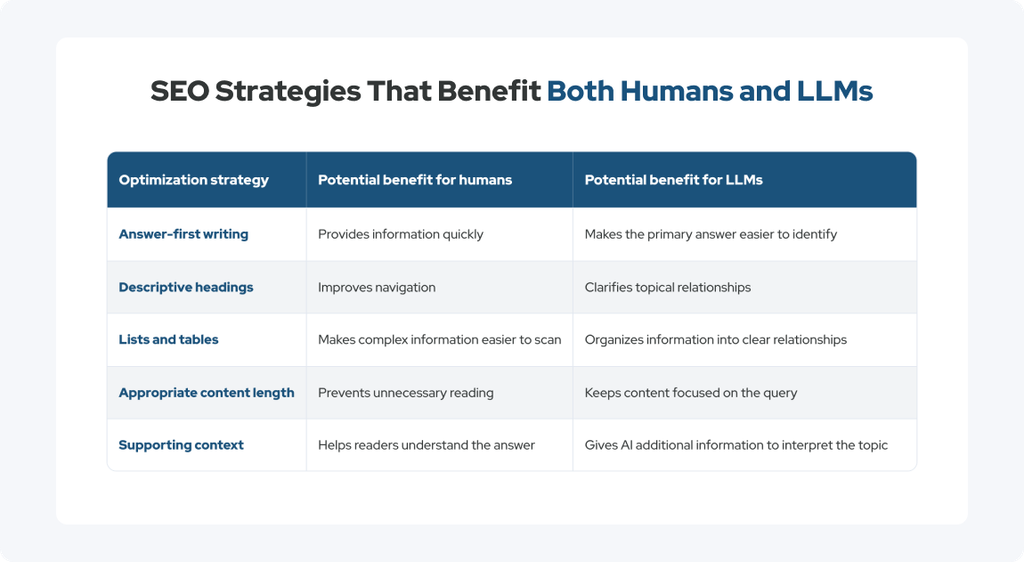
Many principles associated with large language model search engine optimization overlap with established content and user experience (UX) best practices. So, an effective blog or service page will serve a reader looking for an answer, a search engine evaluating relevance, and an LLM attempting to understand and retrieve information from the same source.
What This Means for Content Strategy
Traditional SEO remains relevant, but SEO for AI search requires marketers to think about how information is understood and retrieved within increasingly complex search experiences.
As they pursue AI answer optimization, brands should still keep user intent in mind and ask themselves questions like:
- What does the reader actually need to know?
- Can I answer the primary question sooner?
- What related questions naturally belong on this page?
- Would a table or list make this information easier to understand?
- Are secondary details necessary, or are they creating unnecessary length?
- How does AI currently interpret this topic?
These questions help content teams move beyond simply targeting keywords.
Creating Content That Works Everywhere
At collystring, we consider both traditional search behavior and AI-generated results when evaluating content opportunities. We strive to create the strongest content that is easy for humans to read, search engines to understand, and LLMs to interpret, providing depth when a topic demands it while remaining concise when a question has a straightforward answer.
Our team combines SEO strategy, content expertise, and an understanding of emerging AI search behaviors to help businesses create content that works across today’s evolving search landscape. If your brand needs help with its digital presence, we can be an invaluable resource.
Contact collystring today to develop an SEO and content strategy built for where search is headed.