

Key Takeaways
- AI content writing tools are commonly used to streamline workflows; however, without responsible use, they can erode the reader’s trust and dilute your brand personality.
- Content writers should use AI tools thoughtfully, disclosing their use and editing outputs to guarantee they are accurate and bias-free.
- AI can be helpful in the early stages of content creation, but its outputs should be workshopped to ensure the content is unique and representative of your brand persona.
- As AI continues to play a larger role in content marketing, brands must learn how to utilize this technology to free up time while still prioritizing human-led creativity and authentic storytelling.
The Importance of Brand Personality in the Age of AI
With the recent proliferation of artificial intelligence (AI) content writing tools, many organizations are posting more blogs, service pages, and whitepapers than ever before. In fact, WordPress, the world’s most popular content management system (CMS), reports that its users publish 70 million new posts each month.
With this ever-growing sea of content, it is becoming increasingly challenging for brands to stand out among their competitors, especially if they rely too heavily on AI content writing. AI outputs often default to a generic, polished tone, which can strip away the nuances of a brand’s personality. For content to best resonate with its reader, AI should be used as an assistant, not the voice itself.
Writers must adopt responsible AI principles and infuse all content, from blogs to email campaigns, with a human touch to ensure it accurately represents the brand persona and does not sound bland or overly robotic. The guide below explains what responsible AI is in the context of content writing and how AI content writing tools can be utilized without muting brand personality.
The Prevalence of AI in Modern Content Writing
Thanks to the various advancements and software rollouts that have occurred over the last few years, AI tools are now omnipresent in the digital marketing industry. In fact, 55% percent of marketers use AI for text-based content creation, from blog outlines to ad copy. Some examples of ways AI has been used to supplement content writing include:
- Brainstorming ideas for blogs, email campaigns, or headlines
- Outlining content to speed up research and content formatting processes
- Drafting rough paragraphs that are later refined by a human writer
- Furthering search engine optimization (SEO) through keyword placement and readability checks
The key is knowing how to strategically integrate AI support without entirely outsourcing creativity.
Risks of Overreliance on AI
While AI can increase content marketing effectiveness, you should not rely solely on AI to write your content; otherwise, it can come at a cost. The table below depicts some of the most noteworthy risks associated with overusing AI.
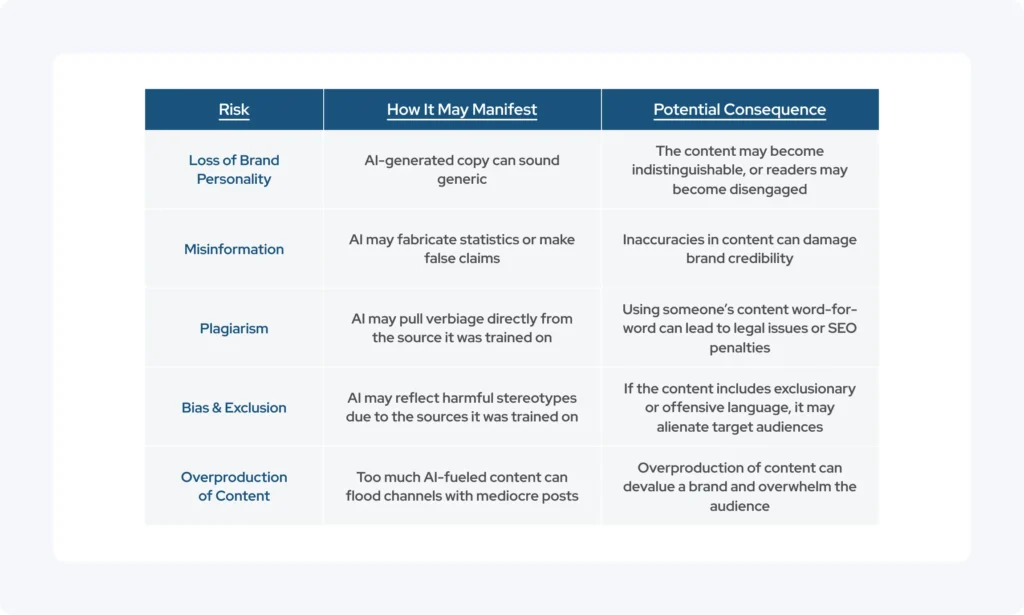
As illustrated in the table above, relying too much on AI content writing can come at a cost to your brand’s personality. To protect your brand persona, AI outputs should be used only as a starting point and a tool for SEO.
What Is a Brand Persona?
Every company has a distinct set of human characteristics that are reflected in its messaging and visuals—this is often referred to as “brand personality.” Some examples of a brand persona are:
- A law firm with a professional and authoritative voice
- A fitness company that embodies an energetic and motivational attitude
- A boutique coffee shop that focuses on being creative and approachable
- A tech startup committed to innovation and curiosity
- A nonprofit that exhibits compassion and community-focused messaging
How to Find Your Brand Persona
Four steps you should take to solidify your brand’s personality are:
- Clearly define your target audience
- Learn about their demographics, preferences, pain points, and motivations
- Consider the personality traits, tone, and values you want your brand to convey
- Ensure that how you want to present your brand aligns with your audience’s expectations
In addition to the four steps above, you can also analyze content from your competitors, gather feedback from customers, and test different messaging styles to further refine your brand persona in a way that feels authentic and has the best chance of resonating with your audience.
Protecting Your Brand Personality Through Responsible AI Content Writing
Your brand persona is what makes your organization unique, so you shouldn’t sacrifice it by being too reliant on AI content writing. It is essential to utilize AI content writing tools responsibly to guarantee the uniqueness of your brand still shines through.
What Is Responsible AI Content Writing?
Responsible AI content writing involves ensuring that text is factually correct, avoiding plagiarism, and accurately reflecting a brand’s identity. AI programs can still be used to enhance creativity and efficiency, but human oversight should remain at the forefront of all content creation.
Some examples of responsible AI principles to keep in mind are:
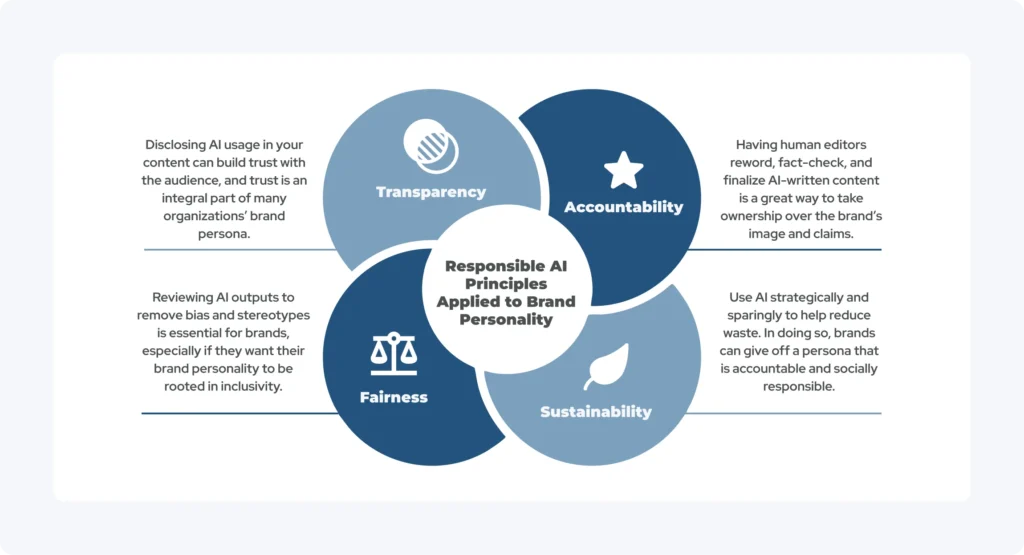
- Transparency – When applicable, you should clearly disclose when AI is used in the content creation process to maintain trust and authenticity.
- Accountability – It is important to hold yourself editorially responsible for the accuracy, originality, and tone of your content.
- Fairness – You should actively avoid biased claims by reviewing AI-generated outputs and making edits to promote inclusivity and equity.
- Sustainability – It is essential to recognize that AI systems consume significant resources; it is crucial to use them sparingly.
By following these responsible AI principles, writers can effectively leverage this cutting-edge technology while still developing credible, ethical content that maintains brand trust and personality.
How to Use AI Responsibly When Writing Content
To maximize the value of written content without compromising integrity or brand personality, writers and marketers should adhere to strict guidelines for AI content writing. Some examples of AI-related rules writers should follow are:
- Ensure your content has a human-sounding voice
- Disclose AI usage when relevant
- Fact-check and cite sources
- Edit for style and personality
- Limit environmental impact
- Train AI with brand-specific prompts
Use AI for Ideation and Humans for Content Creation
Suppose a company wants to publish weekly blogs that are relevant to the industry in which they work. With research and drafting included, a writer who is not using AI at all may take 6 to 8 hours to develop a single blog, depending on the unit’s length. Many small companies lack the resources necessary to consistently put this amount of time into their content production.
When done responsibly, you can introduce AI tools to save time and increase productivity without reducing the quality or impact of the content. For example, you can use Frase.io to generate a research brief, potentially saving you 30 minutes of work. Then, you may be able to use generative AI programs like ChatGPT to produce an outline or barebones rough draft, which may save you up to 2 or 3 hours of work time. Additionally, tools like Clearscope can analyze top-ranking pages and suggest keyword improvements, giving you helpful tips for writing optimized content.
Nevertheless, after using AI to build the foundation, a human writer should flesh out the piece with from-scratch writing and make drastic edits to all of the AI outputs, adding brand personality and performing fact-checks.
With this AI-assisted approach, the writer may only need 3 to 4 hours of time, as opposed to the 6 to 8 that was originally quoted. Most importantly, the resulting blog should still be accurate, original, and aligned with the brand persona.
Future of AI in Content Marketing
As AI programs continue to grow and evolve, the role that this type of software has in content creation will also continue to expand. Natural language models are on track to become even more personalized than they already are. In the same vein, SEO optimization is bound to become more automated, and workflows will continue to integrate.
However, regardless of how advanced AI becomes, the responsible use of AI will remain critical. Brands that over-automate risk compromising their credibility and may sound indistinguishable from their competitors. On the other hand, those that blend AI efficiency with authentic storytelling are more likely to stand out and continue to reap the benefits of their content marketing strategies.
It is crucial to find the perfect balance. Only use AI to handle repetitive tasks, and retain human control over aspects involving creativity, strategy, and personality.
Building Effective Content Strategies with collystring
Many brands mistakenly believe that AI software, such as ChatGPT, is all they need to create successful blogs, service pages, or whitepapers; however, AI content writing tools are just one piece of the puzzle. In today’s world, successful digital marketing requires calculated content strategies built around SEO, responsible AI principles, and distinct brand personas that engage audiences while fortifying trust and authenticity.
By leading with human creativity and data-supported approaches, the content writers and marketing strategists at collystring help brands rise above their competitors who lean heavily on AI content writing. Our professional writers ensure that every unit they produce is human-written and feels organic, only using AI tools for early-stage outlining, research, and optimization. Whether we are working on top-of-funnel blogs that attract organic traffic or bottom-of-funnel service pages designed to convert, each word will align with the client’s unique brand personality.
Contact collystring today for authentic, SEO-driven, and effective content marketing campaigns that will accurately embody your brand’s personality.